
Session 9 - Core Group 101
Building a Core Group
How do you build your core group? You FIND, FEED, and FIGHT for people.
FIND:
By the end of the first interaction, the goal is to find out:
Are they okay with you?
Are they okay with Jesus?
Are they okay with your community?
Do they want one of the above 3?
FIGHT FOR:
Seek 3 interaction points:
Physically pursue through space or interests once a week
Invite to a community space once a week
If you get time and space with them, then make a plan for a 3rd interaction that week
When together seek to pursue them:
Relationally
Spiritually
FEED:
Create rhythms of relationship with them, you, & your community
Large Group on Monday nights
Core Group meeting every week
For the 3 that are the hungriest, begin to feed them one on one.
An essential ingredient: COMMITMENT
Commitment must be:
FIND:
By the end of the first interaction, the goal is to find out:
Are they okay with you?
Are they okay with Jesus?
Are they okay with your community?
Do they want one of the above 3?
FIGHT FOR:
Seek 3 interaction points:
Physically pursue through space or interests once a week
Invite to a community space once a week
If you get time and space with them, then make a plan for a 3rd interaction that week
When together seek to pursue them:
Relationally
Spiritually
FEED:
Create rhythms of relationship with them, you, & your community
Large Group on Monday nights
Core Group meeting every week
For the 3 that are the hungriest, begin to feed them one on one.
An essential ingredient: COMMITMENT
Commitment must be:
- EXPECTED—Follow up with students that don’t show up to core group meeting or events. Show them that you care about them and that they were missed!
- MODELED—As leaders we need to model commitment by attending and being on time to XA events.
- TAUGHT—After your group has had some time to build friendship, you will spend a couple of weeks talking together about what commitment looks like for your group and how to have a shared mission together.
Core Group + Life Group
The goal of core group is to make disciples who will make disciples
If we are not making disciples in all of life, nothing we do in our meetings will matter!
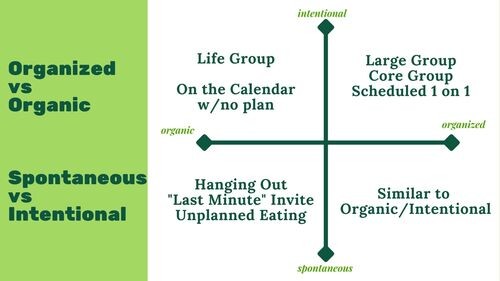
Everything we do as a leadership team to make disciples of each other and of core group members will fall on two continuums
If we are not making disciples in all of life, nothing we do in our meetings will matter!
Everything we do as a leadership team to make disciples of each other and of core group members will fall on two continuums
LIFE GROUP is what?
How Do We Know if We're Doing Life Group Well?
- Place to live life together and have fun
- Place to invite non-Christians to experience the awesomeness that is your Core Group/friends
- Time to have fun with other Core Groups (guys & gals together)
- Time to make memories and solidify friendships
How Do We Know if We're Doing Life Group Well?
- 1 Life Group event happens every week
- You are with your core group outside of core group at least 5 days a week in some form
- People are getting regular and constant invitations
- Everyone in your Core Group gets invited or seen at least once outside of Core Group
Common Core Group Questions
In what kind of environment should a core group take place to make sharing more likely to occur and more comfortable?
- Location is in an apartment, lounge, or dorm room
- TV off, music on, phones away.
- Keep it clean
- Make it refreshing: Something to eat and possibly something to drink. Look to serve & also give opportunities for your students to serve!
- Get your group members involved in helping to set the atmosphere. The more they feel responsible, the higher a level of ownership they will exhibit. Rotate bringing snack/icebreakers/worship songs/life group ideas and any other ways they want to contribute.
- Everyone who enters the room is a big deal.
- Make sure that there is consistency between core groups from week to week so that a level of familiarity can be reached. This will make people comfortable and more likely to share.
- Be prepared to lead.
Know what you’re studying and what you’re leading
Have answers to your icebreaker questions
Have worship music prepared and ready to go
- Obstacles to a successful core group atmosphere can include:
Strange or low lighting.
People passing through all the time.
Allergies
Unusual seating arrangement
Leaders should try to sit on level ground or below core group members.
Too much or too little space.
How large should a core group become?
3 to 5 members (per leader) is close to the ideal number for your core group (green & yellow). This means your total Core Group size will be 8-12. Remember, your core group will be connected to the larger community, so you will also have nonbelievers in your core group who you should see on a weekly basis through life groups. (green, yellow & red) When you include these people the number could range from 3-20!
How long should a core group meeting last?
The optimal time range is 75 to 90 minutes of content. START on time and END on time. Leave them wanting more. Be willing to hang out more after core group officially finishes, but also respect the time of your students. Remember this is NOT the only night of community, so you don’t have to cram it all into Core Group.
How often should the core group meetings occur and when?
Core groups should meet on a weekly basis. For many students, evening is the best time to meet; however, if your group would prefer a morning or afternoon time, feel free to adjust your schedule as needed.
Why are core groups gender segregated?
For many people, issues of self-concept, past problems, sexual and other intimate issues, etc. are of great concern and are best addressed in same-gender core groups. Committing to a brotherhood or sisterhood can enhance commitment and reduce game playing.
We have seen many situations where it is harder for men to be open and committed to other men. We’ve also seen many women having only experienced gossip, infighting, and pain while in a group of women. We also understand that the best place for healing is in a group of your same gender who are committed to Jesus and to one another.
We also do not want to raise up believers that don’t know how to have healthy friendships with the opposite gender. This is why we will stress integration of life groups and in the large group setting.
- Location is in an apartment, lounge, or dorm room
- TV off, music on, phones away.
- Keep it clean
- Make it refreshing: Something to eat and possibly something to drink. Look to serve & also give opportunities for your students to serve!
- Get your group members involved in helping to set the atmosphere. The more they feel responsible, the higher a level of ownership they will exhibit. Rotate bringing snack/icebreakers/worship songs/life group ideas and any other ways they want to contribute.
- Everyone who enters the room is a big deal.
- Make sure that there is consistency between core groups from week to week so that a level of familiarity can be reached. This will make people comfortable and more likely to share.
- Be prepared to lead.
Know what you’re studying and what you’re leading
Have answers to your icebreaker questions
Have worship music prepared and ready to go
- Obstacles to a successful core group atmosphere can include:
Strange or low lighting.
People passing through all the time.
Allergies
Unusual seating arrangement
Leaders should try to sit on level ground or below core group members.
Too much or too little space.
How large should a core group become?
3 to 5 members (per leader) is close to the ideal number for your core group (green & yellow). This means your total Core Group size will be 8-12. Remember, your core group will be connected to the larger community, so you will also have nonbelievers in your core group who you should see on a weekly basis through life groups. (green, yellow & red) When you include these people the number could range from 3-20!
How long should a core group meeting last?
The optimal time range is 75 to 90 minutes of content. START on time and END on time. Leave them wanting more. Be willing to hang out more after core group officially finishes, but also respect the time of your students. Remember this is NOT the only night of community, so you don’t have to cram it all into Core Group.
How often should the core group meetings occur and when?
Core groups should meet on a weekly basis. For many students, evening is the best time to meet; however, if your group would prefer a morning or afternoon time, feel free to adjust your schedule as needed.
Why are core groups gender segregated?
For many people, issues of self-concept, past problems, sexual and other intimate issues, etc. are of great concern and are best addressed in same-gender core groups. Committing to a brotherhood or sisterhood can enhance commitment and reduce game playing.
We have seen many situations where it is harder for men to be open and committed to other men. We’ve also seen many women having only experienced gossip, infighting, and pain while in a group of women. We also understand that the best place for healing is in a group of your same gender who are committed to Jesus and to one another.
We also do not want to raise up believers that don’t know how to have healthy friendships with the opposite gender. This is why we will stress integration of life groups and in the large group setting.